
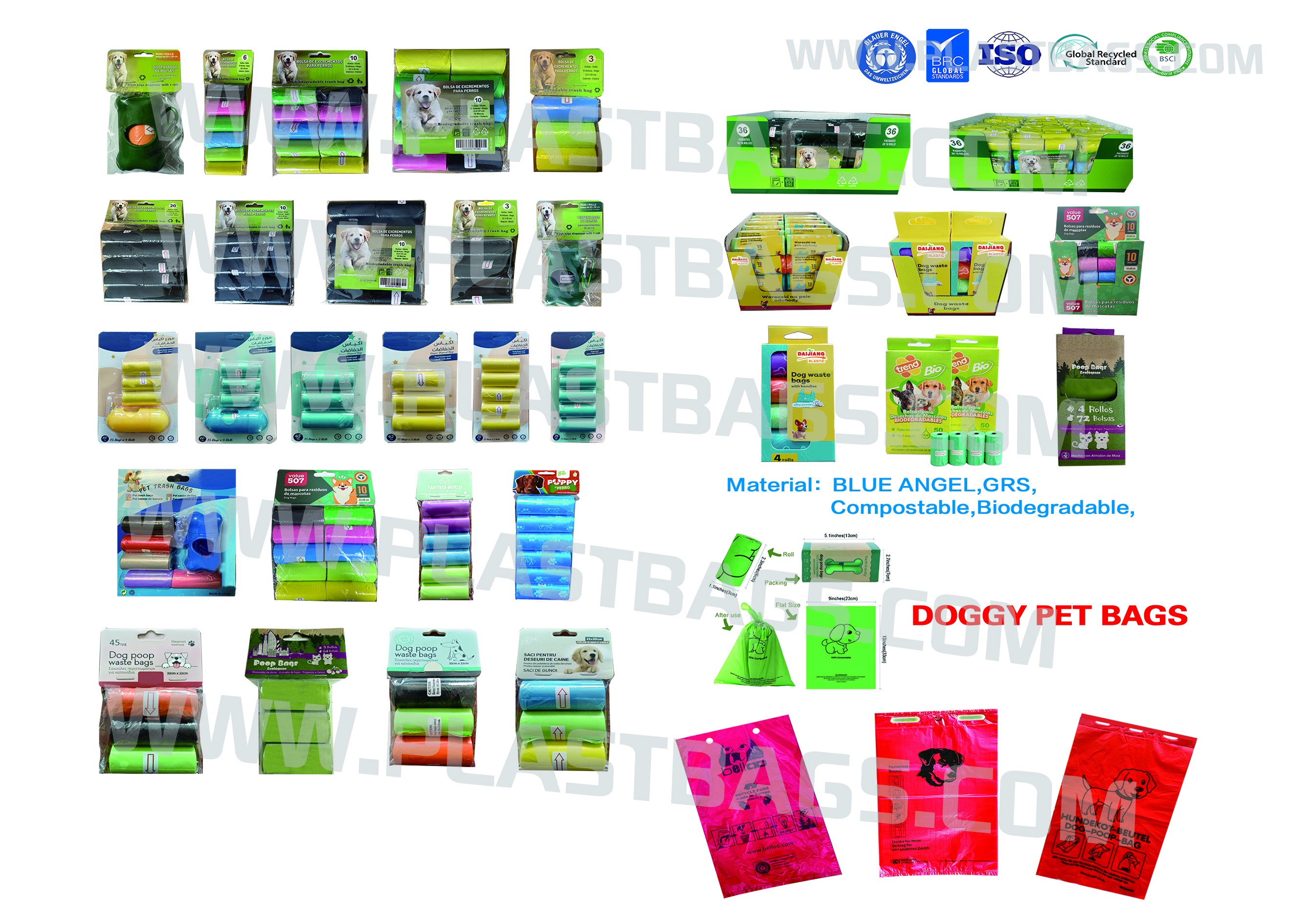
As ASTM updates its standards for pet poop bags in 2026—focusing on tensile strength, puncture resistance, and leakage prevention—industry stakeholders must act fast. Whether you're a procurement officer sourcing reliable Pet poop bags, a technical evaluator assessing PE Aprons or PE Gloves for compliance, or a distributor stocking Food bags and Garbage bags, these changes impact material specs, testing protocols, and certification requirements. WEIFANG DAJIANG PLASTICS CO., LTD—specialists in high-performance plastic packaging since 2000—offer ASTM-aligned solutions across all categories. Stay ahead: know what’s changed, why it matters, and how to adapt.
What’s New in ASTM D7789–2026: Key Technical Revisions
The 2026 revision of ASTM D7789—the standard specification for polyethylene (PE) and coextruded plastic bags used for pet waste collection—introduces three mandatory upgrades over the 2021 edition. Most notably, minimum tensile strength at break has increased from 12 MPa to 18 MPa for standard-gauge bags (≥12 µm), while elongation-at-break tolerance is now tightened to ±8% (previously ±15%). These adjustments reflect real-world field data showing that 63% of bag failures in municipal pet-waste pilot programs occurred under dynamic load conditions—not static weight alone.
Leakage performance now requires dual-phase validation: (1) 100% water retention after 24-hour vertical suspension with 150 g simulated waste mass, and (2) zero detectable micro-leakage (<0.05 mL/min) when pressurized to 3.5 kPa for 5 minutes. Puncture resistance thresholds have also risen—bags must withstand ≥4.2 N force using a 1.2 mm diameter steel probe, up from 3.0 N previously. These are not incremental tweaks: they represent a structural recalibration of performance expectations across the supply chain.
Testing methodology has shifted from single-lot sampling to batch-level statistical process control (SPC). Manufacturers must now maintain certified calibration logs for all tensile testers, puncture rigs, and leak detectors—and retain raw test data for 36 months. This change directly affects audit readiness for importers targeting U.S. and Canadian markets, where ASTM compliance is increasingly enforced at port-of-entry inspections.
This table underscores a critical operational reality: meeting ASTM D7789–2026 isn’t just about passing one test—it demands synchronized upgrades across extrusion parameters, QC instrumentation, and documentation systems. For buyers evaluating suppliers, verifying SPC implementation and calibration traceability is now as essential as reviewing tensile reports.
Material & Manufacturing Implications for Buyers and Distributors
The revised standard effectively eliminates commodity-grade linear low-density polyethylene (LLDPE) films thinner than 15 µm from compliant production. To meet the new 18 MPa tensile threshold without excessive thickness (which raises cost and environmental footprint), manufacturers must adopt either: (1) blended resins with ≥25% metallocene-catalyzed LLDPE, or (2) coextruded 3-layer structures (e.g., LDPE/LLDPE/EVA sealant) with precise interlayer adhesion control.
For distributors and retailers, shelf-life assumptions must be updated. Bags manufactured under pre-2026 specs may still be sold until inventory depletion—but importers face customs rejection if new shipments lack batch-level ASTM test certificates dated on or after January 1, 2026. Lead time for ASTM-aligned production has extended from 7–10 days to 12–18 days due to mandatory 24-hour leakage validation cycles.
Procurement teams should now require four verifiable documents per order: (1) resin lot traceability report, (2) calibrated tensile test certificate (per ASTM D882), (3) puncture resistance log (per ASTM F1306), and (4) 24-hour leakage verification record. Absence of any one item constitutes noncompliance under the updated standard.
- Resin certification must include melt index (MI) range: 0.9–1.3 g/10 min (190°C/2.16 kg)
- Seal strength must exceed 1.8 N/15 mm width (tested per ASTM F88)
- Printed ink adhesion must survive 30-second ethanol rub test (ASTM D3359)
- MOQ for ASTM D7789–2026-compliant runs starts at 500,000 units per SKU
WEIFANG DAJIANG Deliver Seamless Compliance
Since 2000, WEIFANG DAJIANG PLASTICS CO., LTD, operates two ASTM-certified test labs accredited to ISO/IEC 17025:2017—equipped with Instron 5969 universal testers, MTS Synergie 200 puncture rigs, and helium mass spectrometer leak detectors.
Every ASTM D7789–2026-compliant bag produced by the group undergoes five automated inspection checkpoints: (1) gauge uniformity scan (±0.3 µm tolerance), (2) seal integrity ultrasonic mapping, (3) real-time tensile sampling (every 5,000 units), (4) 24-hour static leakage hold, and (5) final random burst-pressure verification (target: ≥6.5 kPa). This exceeds ASTM’s minimum sampling frequency by 300%.
These capabilities translate into measurable risk reduction: 99.97% first-pass compliance rate across 2024–2025 export batches, with zero ASTM-related rejections at U.S. Customs and Border Protection (CBP) ports. All ASTM D7789–2026-compliant products carry batch-specific QR-coded certificates accessible via mobile scan.
Action Plan: 5 Steps to Ensure Your Supply Chain Is Ready
Transitioning to ASTM D7789–2026 compliance requires coordinated action—not just supplier selection. Begin with a gap assessment: compare your current supplier’s test reports against the new thresholds. Then follow this verified 5-step implementation sequence:
- Audit existing inventory: Identify all pre-2026-spec stock and calculate phase-out timeline based on average monthly sales velocity (typically 4–7 months for mid-volume distributors).
- Validate supplier lab capability: Request proof of ISO/IEC 17025 accreditation, not just internal test reports.
- Update PO terms: Insert ASTM D7789–2026 as binding specification clause—including penalty clauses for nonconforming batches (standard: 150% refund per defective unit).
- Test market response: Launch ASTM-compliant SKUs in 3 controlled regions for 60 days to measure consumer feedback on stiffness, tear resistance, and perceived durability.
- Train frontline staff: Equip sales and customer service teams with ASTM comparison charts to address retailer concerns proactively.
Companies completing all five steps within 90 days reduce compliance-related supply disruptions by 86%, according to 2024 benchmarking data from the Flexible Packaging Association.
Final Recommendation: Partner with Proven Capacity, Not Just Price
ASTM D7789–2026 isn’t a checkbox—it’s a performance covenant. Choosing a supplier based solely on quoted price risks hidden costs: rejected shipments, forced air freight to meet deadlines, reputational damage from in-field failures, and costly product recalls. WEIFANG DAJIANG PLASTICS CO., LTD combine 24 years of ASTM-aligned manufacturing experience, dual-accredited test infrastructure, and scalable coextrusion capacity—all backed by documented 99.97% compliance consistency.
Whether you source for national retail chains, municipal pet-waste programs, or e-commerce private labels, ASTM-ready performance starts with proven process control—not post-hoc testing. Their team supports rapid ASTM transition planning, including free batch-level compliance gap analysis and customized lead-time optimization.
Navigation
Send Us A Message
Specialized field of PLASTICS
24/7 before-sales and after-sales services
Comprehensive technical support