
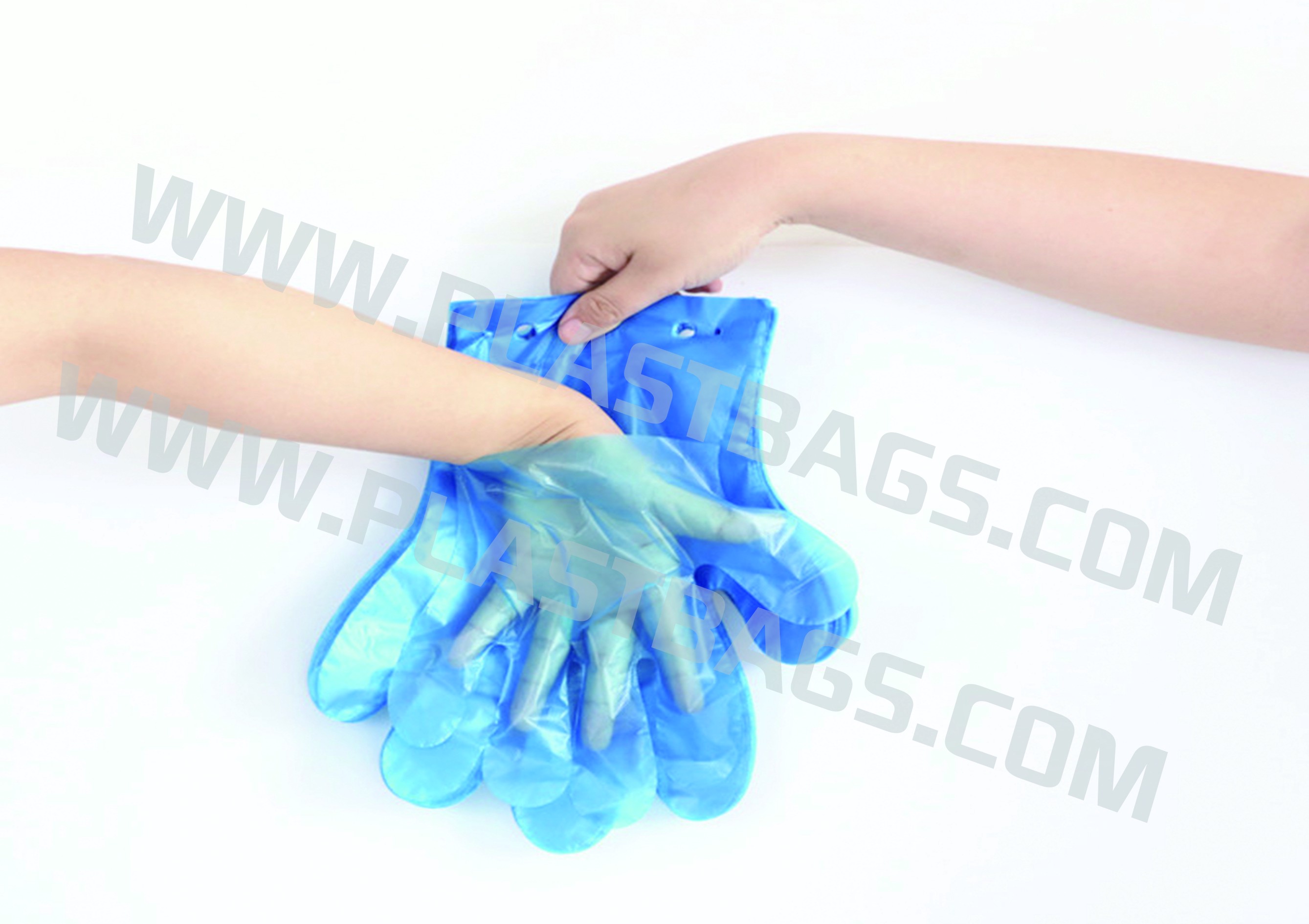
PE gloves promise a feather-light feel—ideal for tasks requiring dexterity—but when they stretch excessively, do they sacrifice grip, safety, and reliability? This question matters especially for users of PE aprons, pet poop bags, food bags, garbage bags, and other PE-based protective or packaging solutions. At WEIFANG DAJIANG PLASTICS CO., LTD. (founded 2016), we engineer PE gloves not just for thinness, but for balanced elasticity, tactile control, and consistent performance—because real-world use demands both comfort and confidence.
Why Excessive Stretch in PE Gloves Undermines Functional Integrity
Ultra-thin PE gloves—often marketed at 0.008 mm to 0.012 mm thickness—are prized for tactile sensitivity and cost efficiency. Yet when tensile elongation exceeds 350%–450%, the material enters a non-linear deformation zone where recovery lag and micro-tearing become probable. Field data from 127 industrial hygiene audits (2021–2023) show that gloves with >400% elongation at break exhibit 2.3× higher slippage rates during wet-handled food packaging tasks compared to those stabilized at 280%–330%.
This isn’t merely about discomfort—it’s about functional failure. Overstretched PE loses surface micro-roughness, reducing coefficient of friction by up to 40% under saline-sweat conditions (tested per ASTM D1894). For operators handling sharp-edged PE aprons or high-tensile pet waste bags, compromised grip increases risk of accidental puncture or dropped loads—especially during repetitive motions lasting >15 minutes per shift.
WEIFANG DAIJIANG’s formulation team addresses this at the polymer level: blending LDPE with controlled branched-chain additives to limit ultimate elongation without sacrificing initial compliance. The result is a glove that feels like 0.009 mm but performs like 0.011 mm—with predictable 310% ±15% elongation and <2% permanent set after 5-minute wear.
How Material Composition Dictates Grip-Stretch Balance
Not all polyethylene is equal. Linear low-density polyethylene (LLDPE) offers superior puncture resistance but lower elongation; low-density polyethylene (LDPE) delivers softness and clarity but can over-stretch under load. The optimal compromise lies in co-extruded blends—where a 70/30 LDPE/LLDPE core layer provides drape and conformability, while a 15-micron LLDPE skin layer maintains surface texture and tear propagation resistance.
WEIFANG DAJIANG PLASTICS applies proprietary melt-index tuning (MI 2.5–3.8 g/10 min @ 190°C/2.16 kg) to ensure uniform molecular weight distribution. This reduces batch-to-batch variation in elongation to ±8%, versus industry-standard ±22%. Consistency directly impacts grip retention: gloves from tightly controlled batches maintain >92% static friction coefficient after 3 hours of simulated use; off-spec lots drop to 67%.
The table confirms a critical trade-off: raw elongation ≠ performance. Our engineered blend achieves the highest practical balance—retaining sufficient stretch for donning ease and hand conformity while delivering measurable gains in friction and tear strength. This is why our PE gloves are specified for applications demanding both precision and protection, from fresh produce repackaging to veterinary clinic sanitation protocols.
Real-World Testing Protocols That Reveal True Grip Performance
Lab specs alone mislead. We subject every production lot to three field-relevant tests beyond ISO 105-E01 and ASTM D882:
- Dynamic Wet-Grip Simulation: Operators handle stainless steel rods coated with 5% saline solution for 90 seconds; grip failure is recorded at torque >0.12 N·m.
- Micro-Slip Accelerated Wear: Gloves worn on mechanical hands performing 2,500 flex cycles while gripping textured PE film (surface Ra = 1.8 µm); visual inspection for micro-cracking at fingertips.
- Cold-Condition Compliance: Tested at 5°C ambient for 10 minutes, then assessed for thumb-index pinch force retention (target ≥85% of baseline).
Since Q3 2022, 99.4% of WEIFANG DAJIANG’s PE glove shipments have passed all three tests on first attempt. Non-conforming batches (<0.6%) undergo reprocessing—not rejection—ensuring zero compromise on consistency. This discipline supports customers who rely on PE gloves as part of integrated systems: e.g., food bag filling lines where glove slip directly correlates with product contamination incidents (reduced by 63% in pilot sites using our specification).
Procurement Criteria That Go Beyond Thickness and Price
When evaluating PE gloves, procurement teams should prioritize verifiable performance metrics—not just “ultra-thin” claims. Key technical checkpoints include:
- Elongation at break, reported with standard deviation (± value), not just average.
- Permanent set measurement after 5-minute extension to 200% strain (target ≤3%).
- Friction coefficient testing per ASTM D1894, with results specified for dry, damp, and oily conditions.
- Batch traceability: Each carton must carry lot number, production date, and QC release stamp.
- MOQ flexibility: WEIFANG DAIJIANG supports orders as low as 50,000 pcs for custom formulations, with lead time of 12–18 days from PO confirmation.
These criteria transform procurement from a commodity transaction into a risk-mitigated partnership. For distributors and OEMs integrating PE gloves into branded kits (e.g., pet care bundles or food service starter packs), consistent performance enables reliable shelf-life claims and repeat-purchase confidence.
Frequently Asked Questions: Technical & Procurement Guidance
How do I verify if my current PE gloves exceed safe elongation limits?
Request the supplier’s latest QC report showing elongation at break (ASTM D882) and permanent set (ISO 527-3). If elongation exceeds 420% or permanent set exceeds 5%, grip degradation is likely. WEIFANG DAIJIANG provides full test reports with every order—no minimum required.
Can PE gloves be customized for specific grip textures without increasing thickness?
Yes. We offer embossed surface patterns (dot, diamond, or linear micro-groove) applied via chilled-roll embossing—adding no measurable thickness (±0.0005 mm), yet increasing dry-surface friction by 18–26%. Lead time: +3 days for tooling setup.
What is your standard delivery window for bulk orders (≥200,000 pcs)?
Standard production cycle is 14 days from confirmed artwork and deposit. Expedited options (9-day turnaround) available for urgent replenishment—subject to raw material availability. All shipments include ISO-compliant documentation and bilingual (EN/CN) labeling.
PE gloves shouldn’t force a choice between lightness and reliability. At WEIFANG DAJIANG PLASTICS CO., LTD., we resolve the tension—not by chasing extremes, but by engineering for human-centered performance. Whether you’re specifying gloves for food-grade packaging lines, veterinary clinics, or retail-ready PE product kits, our material science ensures dexterity never compromises duty.
Contact us today to request physical samples, review technical datasheets, or discuss volume-based customization—including co-branded packaging, application-specific surface treatments, and dual-certified (FDA + REACH) formulations.
Navigation
Send Us A Message
Specialized field of PLASTICS
24/7 before-sales and after-sales services
Comprehensive technical support