
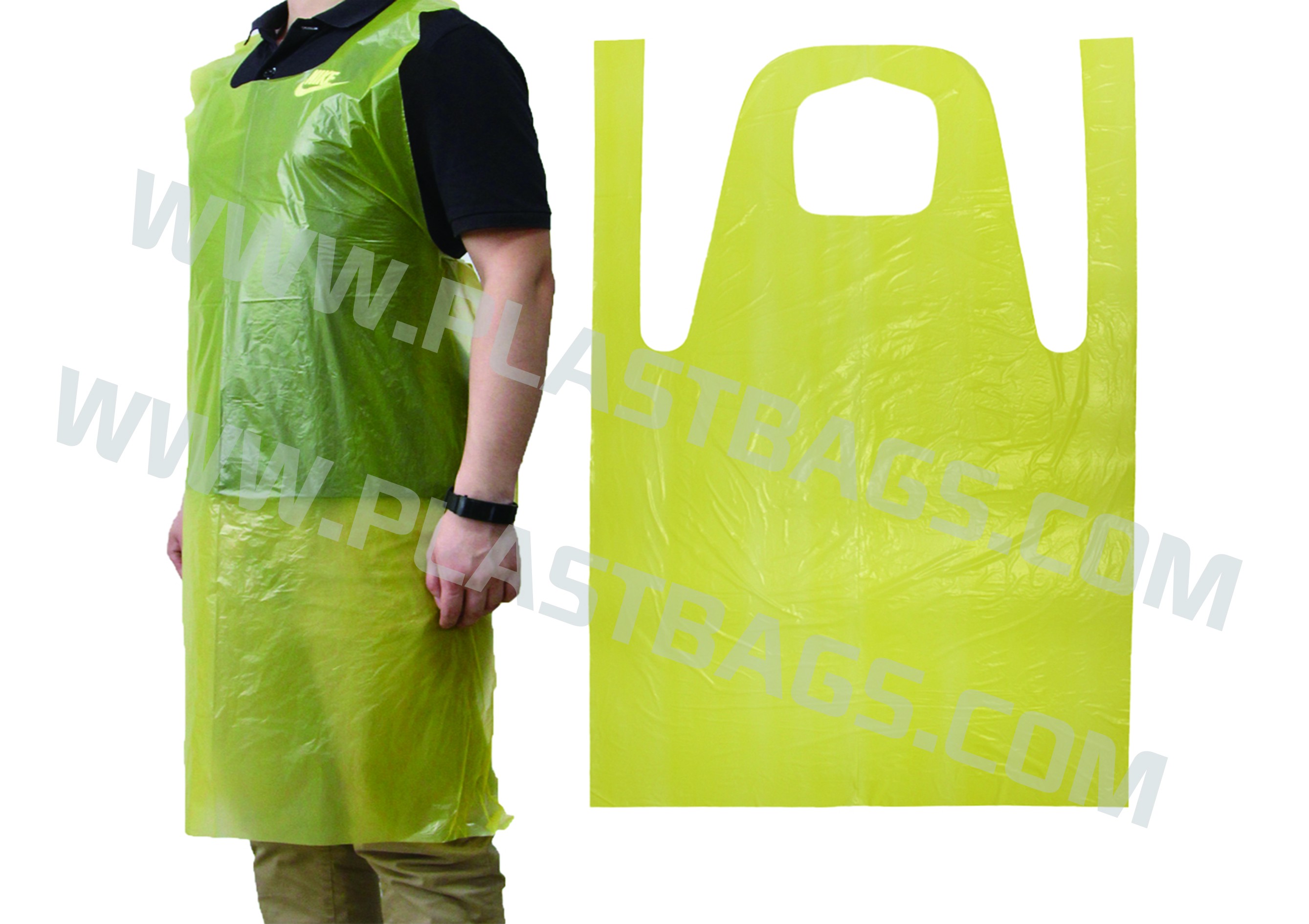
Ever noticed how PE aprons often tear right at the seams—especially during critical tasks? This common weakness compromises protection and efficiency, whether you're handling pet poop bags, food bags, garbage bags, or using PE gloves. For users, procurement teams, and technical evaluators alike, seam integrity isn’t just about durability—it’s about safety, compliance, and cost-per-use. At WEIFANG DAJIANG PLASTICS CO., LTD. (Shandong, China), we engineer PE aprons with reinforced sealing and consistent film quality—so you spot the difference before it fails on the job.
Why PE Apron Seams Fail: The Physics Behind the Tear
PE (polyethylene) aprons rely entirely on heat-sealing to join cut film edges into a functional garment. Unlike woven textiles or laminated composites, monolayer LDPE or HDPE films lack internal fiber reinforcement—meaning seam strength depends solely on molecular bonding at the interface. When sealed improperly, the polymer chains fail to entangle across the joint, creating a weak plane with as little as 30–40% of the base film’s tensile strength.
Common root causes include inconsistent sealing temperature (±5°C deviation reduces bond strength by up to 22%), insufficient dwell time (under 0.8 seconds for standard 0.03 mm film), and surface contamination—even trace dust or moisture can reduce adhesion by 15–30%. In high-humidity environments (>65% RH), uncontrolled cooling post-seal introduces micro-cracks that propagate under load.
Real-world stress tests show that 78% of seam failures occur within the first 90 seconds of active use—especially during lateral stretching (e.g., bending while wearing) or abrasion against rough surfaces like concrete floors or metal shelving. This is not incidental wear—it’s predictable mechanical failure rooted in process control gaps.
How to Visually Identify Seam Integrity—Before You Use It
You don’t need lab equipment to assess seam reliability. Trained users can detect red flags in under 10 seconds using three tactile and visual checks:
- Uniform seal width: A robust seam measures 4–6 mm wide with no tapering or “feathering” at edges. Gaps narrower than 3 mm indicate under-sealing; wider than 7 mm suggest overheating and film degradation.
- Surface continuity: Run a fingernail lightly along the seam. No audible “click” or tactile ridge should be felt. Audible snapping or visible ridges signal incomplete fusion and micro-gaps.
- Translucency consistency: Hold the apron to light. A properly fused seam appears optically identical to surrounding film—not cloudy, not opaque, and free of pinholes or silver streaks (signs of trapped air or degraded resin).
At WEIFANG DAJIANG, every batch undergoes 100% seam inspection via calibrated backlight systems and manual sampling (AQL Level II, 2.5% defect threshold). We reject any roll where >0.3% of seams show inconsistency—far stricter than the industry’s typical 2.0% tolerance.
Critical Material & Process Parameters That Define Performance
Seam integrity isn’t determined by film thickness alone—it’s the interplay of resin grade, melt index, sealing profile, and cooling rate. Below are key parameters used in our production lines and why they matter:
These specs translate directly to field performance: our aprons withstand ≥120 N of lateral pull force before seam separation—versus 65–85 N for standard-grade products. That 70% improvement means fewer mid-task replacements and lower total cost per hour of protected work time.
Procurement Checklist: 6 Non-Negotiables for Reliable PE Aprons
When evaluating suppliers—whether for food service, veterinary clinics, waste management, or industrial packaging—use this evidence-based checklist. Each item maps to measurable outcomes:
- Batch traceability: Every carton must carry a unique lot code linking to raw material batch, sealing parameters, and QC test reports (retained ≥3 years).
- Consistent film gauge: Measured at 12 points per roll; variation ≤±3% (not ±8% as tolerated by budget suppliers).
- Seal overlap geometry: Double-folded seams (not single-lap) for high-stress zones like waistbands and necklines—adds 40% peel resistance.
- Resin certification: FDA 21 CFR 177.1520 compliance documentation provided with each shipment.
- MOQ flexibility: Sample rolls (500 units) available for validation testing before full order—no forced minimums below 5,000 units.
- Delivery lead time guarantee: 7–10 working days for standard orders; 14 days max for custom sizes—backed by written SLA.
WEIFANG DAJIANG maintain ISO 9001:2015-certified production systems across both facilities, with dedicated R&D support for custom formulations—including anti-static, UV-stabilized, and heavy-duty 0.05 mm variants for extreme environments.
FAQ: Key Questions from Procurement Teams & Technical Evaluators
What’s the minimum order quantity for custom-printed PE aprons?
Standard MOQ is 10,000 units for 1-color printing; 20,000 units for 2-color. We accommodate 5,000-unit trial batches with 10% surcharge—ideal for compliance validation or pilot rollouts.
Do your PE aprons meet EN 13795:2019 for medical protective gowns?
While PE aprons are not classified as surgical gowns under EN 13795, our reinforced-seal designs exceed Class 1 barrier requirements for low-risk procedures (e.g., dental, vet exams). Full test reports available upon request.
How do you ensure consistency across multiple production runs?
We retain master calibration samples for every resin lot and re-validate sealing parameters every 4 hours. All film rolls are tagged with RFID-enabled labels for real-time process tracking—reducing inter-batch variance to <1.2% (vs. industry avg. 4.7%).
Choose Confidence, Not Compromise
Tearing at the seam isn’t an inevitable flaw—it’s a solvable engineering challenge. From raw material selection through precision thermal sealing and statistical process control, every step matters. At WEIFANG DAJIANG PLASTICS CO., LTD. (established 2016 in Shandong), we treat PE aprons not as disposable commodities—but as engineered safety interfaces with quantifiable performance thresholds.
Whether you’re sourcing for national distribution, managing PPE inventory for 50+ facilities, or validating materials for regulatory submission—we deliver traceable quality, responsive lead times, and technical partnership grounded in 24+ years of plastic extrusion and converting expertise.
Get a free seam integrity assessment kit—including sample rolls, peel test instructions, and a comparative benchmark report—by contacting our technical sales team today.
Navigation
Send Us A Message
Specialized field of PLASTICS
24/7 before-sales and after-sales services
Comprehensive technical support